The Benefits When Resources Meet Relationships for Children in High-Poverty Communities

Children born into poverty face systemic barriers that create disparities long before they enter the workforce. Novel research by scholars Benjamin Goldman and Jamie Gracie shows providing students born into low-income families with personalized supports, whether in the form of academic, social, housing, or health assistance, significantly raises test scores, boosts high school graduation rates, and improves adult earnings.
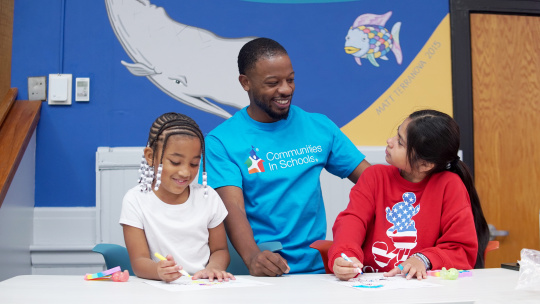
Authored by Goldman, Assistant Professor of Economics and Public Policy at Cornell University, a Research Principal at Opportunity Insights and a former Linda G. Hammett Ory Fellow and current Research Affiliate at EdRedesign; and Gracie, a former Linda G. Hammett Ory Fellow and current Postdoctoral Fellow with EdRedesign and an Affiliate of Opportunity Insights, the working paper titled, “When Resources Meet Relationships: The Returns to Personalized Supports for Low-Income Students,” evaluates Communities In Schools (CIS), a program that places a "site coordinator" in high-poverty schools to connect students with both in-school supports (such as tutoring and mentoring) and out-of-school resources (including nutrition and housing supports, and health services), tailored to their individual needs.
Research and Policy Brief
The latest research and policy brief from EdRedesign showcases the evidence that pairing traditional school and community resources with relationship-based personalization dismantles barriers to opportunity for children and advances upward mobility. A practical guide for policymakers, community leaders, and other experts, the policy brief not only breaks down Goldman and Gracie's research but also highlights how to put it into action.
Academic Paper and Non-Technical Summary
Read the paper Read the non-technical summary